
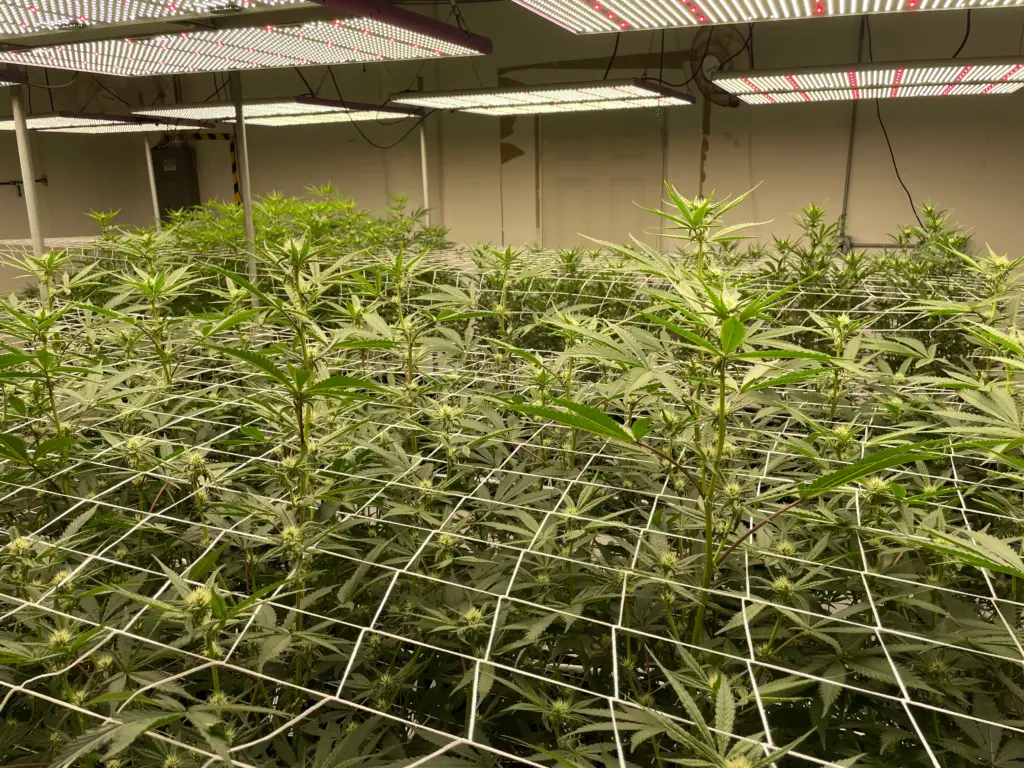
What to look for, where to shop, and why small-batch flower is worth it
Buying cannabis in Sanford is easy now. Knowing what you’re buying is the hard part, and that’s what this guide is for.
The number of places to buy cannabis in York County has grown fast. Sanford, Springvale, Biddeford, Waterboro, all of it. What has not grown at the same rate is anyone explaining how to tell the products apart once you are standing there looking at a shelf.
We grow in Sanford. Small batches, hand trimmed, in this climate. So this is written from the grow side rather than the retail side, and it is mostly about one question: how do you look at a jar of flower and know whether it was grown well?
You will not need to know a single cultivar name to use any of this.
Why Maine ends up with a lot of small growers
Maine’s cannabis industry developed differently than most states. It came up through a caregiver system built around small independent operators, years before large scale commercial cultivation showed up. That history is still visible on shelves here in a way it is not in, say, Colorado or Michigan.
The climate reinforces it. Maine is not a place where you run enormous cheap greenhouses year round. Heating and lighting cost real money from October through April. That economic reality pushes growers here toward smaller, more controlled rooms and away from raw volume.
The practical result for you: in York County, you are often choosing between flower from an operation running thousands of plants and flower from someone running dozens. Both are legitimate. They are just optimizing for different things, and you can see the difference with your own eyes once you know where to look.
What “small batch” actually means
The phrase gets used loosely enough that it has almost stopped meaning anything, so here is the specific version.
Large scale cultivation optimizes for volume and consistency. That is a genuine skill and it is the reason shelves stay stocked. The tradeoff is that harvest timing, trimming, and cure length all get pushed toward whatever the production schedule allows. If a room needs to be turned over on the 15th, it gets harvested on the 15th.
Small batch inverts that. Fewer plants per run, harvest called on how the plants actually look rather than what the calendar says, hand trim instead of machine, and a longer cure. It is more labor per gram and the output is limited, which is exactly why small batch flower rotates in and out of stock instead of sitting there indefinitely.
That limitation is not a marketing angle. It is the actual constraint.
How to read a jar
Four things, in order of how much they tell you.
1. The nose
Open it and smell it before anything else. You want something distinct. Fuel, citrus, pine, gas, sweet, funk, whatever it is, it should announce itself.
What you do not want is hay, grass clippings, or nothing at all. Hay usually means it was dried too fast or too hot. Nothing at all usually means it has been sitting too long, or the terpenes were cooked off somewhere in the process. Flower that smells like flower is the baseline, and a surprising amount of product does not clear it.
2. The trim
Look at the edges of the buds. Hand trimmed flower keeps its shape, with sugar leaves tucked in and the structure intact. Machine trimmed flower tends to look uniformly rounded, a little beaten up, with broken trichomes and a slightly dusty surface.
Machine trim is not evil. It is how you process large volume. But it is a reliable signal about which kind of operation you are buying from.
3. The cure
Squeeze a bud gently. It should have some give and then spring back. Crumbling to powder means over dried. Feeling damp or spongy means under dried, which is a mold risk and not worth it at any price.
Cure is where a lot of otherwise good flower gets ruined, and it is the step that gets cut first when a schedule is tight. It is also the step you can most easily check yourself.
4. The harvest date
If a package has a harvest or packaged date, read it. Flower is not wine. It does not improve for a year in a jar. There is a window where it is at its best and then a long slow decline in aroma and character.
Recent is generally better. If nothing on the label tells you when it was harvested, that is itself a piece of information.
The thing most people get wrong
Shopping by THC number.
It is understandable. It is the one number printed in large type, so it feels like the objective measure. It is not a very good one. Two jars testing within a couple of points of each other can be completely different experiences, because the aroma compounds, the cure, and the overall quality of the grow drive far more of what you actually notice than that single figure does.
Testing variance between labs is also real and well documented across the industry. The number is a rough guide, not a grade.
A better filter: pick by nose and by how the flower looks, and let the number be a tiebreaker rather than the first thing you check. Budtenders universally know this. Most are glad when someone asks a different question.
Questions worth asking at the counter
You do not need vocabulary. You need to describe your own experience.
- “What came in most recently?”
- “What is this one like on the nose?”
- “I liked something that was citrusy and not too heavy. What is close to that right now?”
- “What did you personally think of this?”
That last one gets you further than anything else. The person behind the counter has usually smelled everything on the shelf that week.
What does not work well is walking in and asking for the strongest thing. You will get an answer, but it will be an answer to the wrong question.
Seasonality, sort of
One quirk of buying from small Maine growers: availability moves in waves. A cultivar you loved in March may genuinely not exist in June, because it was a limited run and the next run is a different plant entirely.
That frustrates people who want the same jar every week, and it is a fair frustration. The upside is that it means the shelf changes, and there is usually something new to try. If you find something you love from a small batch grower, buy it while it is there. That is not a sales line, it is just how limited runs work.
Where we fit in
We are Enzy Farms, a small craft cultivator at 72 Emery St in Sanford, ME. Everything above is how we think about our own flower, which is why we are comfortable telling you to smell it and squeeze it before you commit.
You can pick up in store Monday through Friday, or curbside on Saturday and Sunday. We also deliver to Sanford, Springvale, Lyman, Lebanon, Acton, Shapleigh, Waterboro, North Waterboro, Limerick, Buxton and Biddeford, with minimums that vary by town. Full hours, delivery zones and minimums are on our pickup and delivery page.
Because runs are small, the live menu is the only accurate source for what is in stock right now. Questions, call us at (207) 819-5092.
Please consume responsibly. Keep out of reach of children and pets.